|
|
The Museum of Natural History is set in the former courts of the 18th century. It displays collections of palaeontology, zoology along with 8000 drawings and manuscripts of the naturalist Charles Alexandre Lesueur (a unique collection).
Completely destroyed in the bombings of September 1944, the building was restored and reopened to the public in 1973.
It shelters collections of palaeontology, zoology, prehistory and the permanent iconographic collection (about 8000 drawings and manuscripts) of Charles Alexandre Lesueur.
Charles Alexandre Lesueur (1778-1846) was a naturalist drawer from Le Havre; he travelled, discovered and drew either on official business or independently. He mainly travelled around France and in the “Southern lands” (Australia) with the expedition of Nicolas Baudin (1800-1804), commissioned by Bonaparte, and then in the United-States. He brought many testimonies on these regions of the world at the beginning of the 19th century.
Lesueur paints with a magnifying glass and a brush bearing only a couple of bristles. When one looks at a watercolour on vellum paper with a magnifying glass, the drawing takes shape with an amazing relief.
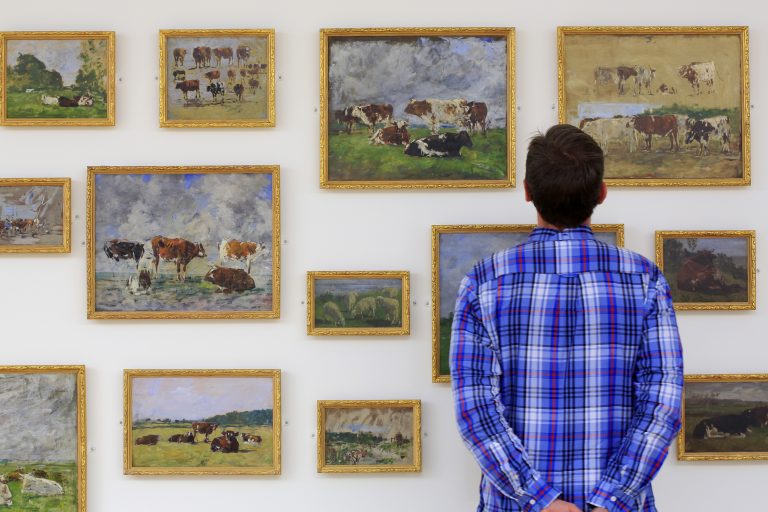
The exhibition of these drawings requires a strict control of the temperature, the hydrometry and the lighting of the room. In spite of all these precautions, the exhibition of a drawing during three months is followed by three consecutive years of rest in the reserve collection. So as to allow the public to discover this exceptional collection of naturalist graphic arts, the Museum will display four exhibitions of drawings every year, a different one for each season.
|
| |
|
|
|